


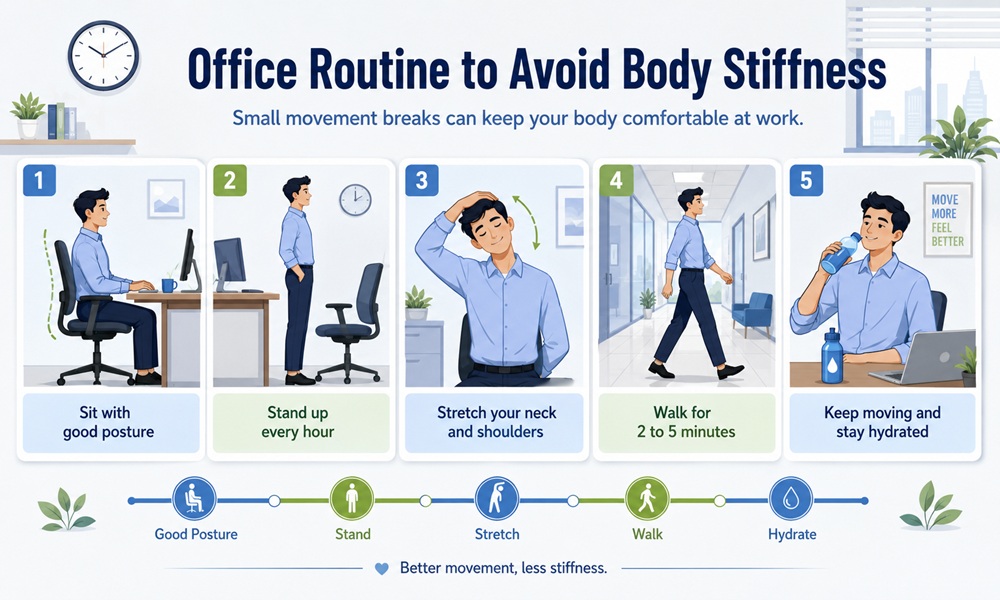
Sitting still is what stiffens you — not bad posture alone. Around 60% of adults sit for more than six hours a day, and poor desk habits drive a large share of workplace aches, with much of the related musculoskeletal strain considered preventable. The human body is built to move, so the real cure is frequent motion throughout the day, not finding one “perfect” position and freezing in it.
Quick answer: Move every 30–60 minutes (micro-breaks even more often), use the 20-20-20 rule for your eyes, alternate sitting and standing, and run through a few desk stretches each hour. Variety beats rigid stillness.
Why “perfect posture all day” is a myth
Holding any single position for hours eventually becomes uncomfortable — even an ideal one. Your body dislikes static loading more than imperfect posture. Regular position changes and small, frequent movements reduce muscle fatigue and joint stiffness far more effectively than trying to sit perfectly upright for eight hours straight. So give yourself permission to shift, fidget and move.
The hourly office routine
| Interval | Do this |
| Every 20 min | 20-20-20: look 20 feet away for 20 seconds, and sit back into your chair |
| Every 30–60 min | Stand, walk, or stretch for a minute or two |
| Each hour | Run through the quick desk-stretch set below |
| Across the day | Alternate sitting and standing if you have a sit-stand desk |
| Lunch | Take a short walk, ideally outside for some daylight too |
The 1-minute desk stretch set
These take about a minute total and target the areas that tighten most from desk work — the neck, shoulders, upper back and hips.
- Chin tuck. Glide your head straight back into a gentle “double chin,” then release. This eases the forward-head strain that builds over a long day.
- Shoulder rolls. Roll your shoulders up, back and down 10–15 times, then reverse the direction.
- Seated spinal twist. With a hand on the chair back, gently rotate your torso each way and hold for 15–30 seconds.
- Neck side stretch. Tilt one ear toward your shoulder and hold for 15–30 seconds per side (skip it if you feel any tingling or arm symptoms).
- Stand and hip-flexor reach. Stand tall, step one foot back, and gently open the front of the hip, which shortens from sitting.
Set up your workstation
- Position the top of your screen at about eye level, roughly an arm’s length away.
- Keep elbows near 90°, wrists neutral, and shoulders relaxed (not hunched).
- Plant your feet flat on the floor with thighs roughly parallel to the ground.
- Use a headset for calls instead of cradling the phone against your neck.
- Remember a standing desk is a tool, not a cure — the benefit comes from switching positions, since standing all day creates its own problems.
Strengthen the support muscles
Stiffness and back pain are often stability problems as much as flexibility ones. A little strengthening makes long periods of sitting far more comfortable:
- Glute bridges and short planks for core and hip support
- Shoulder-blade squeezes to counter the rounded-forward posture
- Seated marches or leg lifts you can do right at your desk
- Aim for 150–300 minutes of moderate activity across the week overall
Insight: micro-breaks beat marathon stretches
Research on desk workers shows that small, frequent movement breaks reduce muscle discomfort — and crucially, without hurting productivity. In fact, many short “resets” through the day work better than one long stretch session at the end. Whole-body movement also beats focusing on a single area, because it restores circulation everywhere rather than just loosening one tight spot. The simplest rule of all: if you have been still for a while, get up and move, even for thirty seconds.
Frequently Asked Questions
How often should I get up from my desk?
A useful guideline is a short break every 30–60 minutes, with even more frequent micro-resets — standing or stretching every 10–15 minutes — to stop stiffness from setting in.
Do standing desks fix stiffness?
Only partly. The real benefit is the ability to alternate between sitting and standing; standing all day brings its own aches, so the goal is variety.
What if I already have back or neck pain?
Keep your movements gentle and frequent, avoid sitting through pain, and see a physical therapist or clinician if the pain persists or worsens.
Are desk stretches actually effective?
Yes — studies show brief, regular stretching and movement during computer work reduces musculoskeletal discomfort. Consistency matters more than intensity.
