


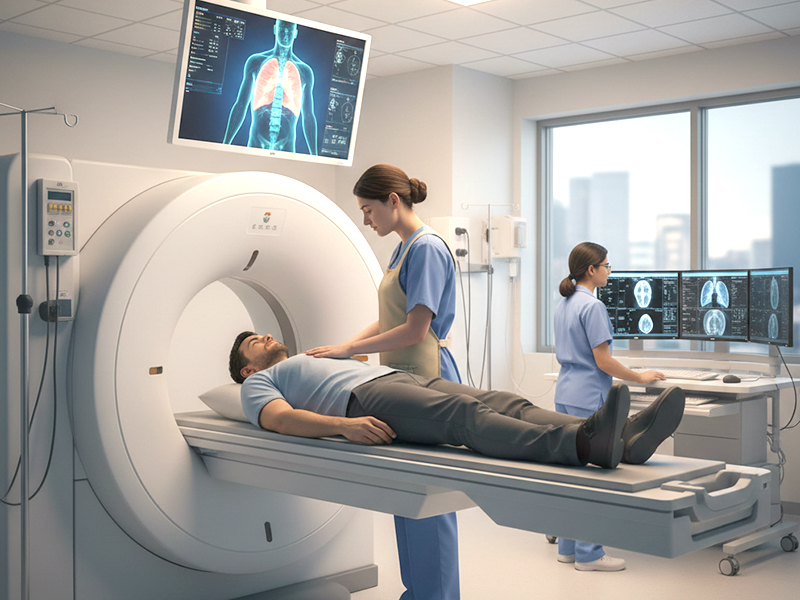
HRCT (High Resolution Computed Tomography) is a useful imaging modality to evaluate and characterise lung diseases with high precision. It is commonly recommended in cases of chronic lung disease, diffuse lung disorders and pulmonary tuberculosis. It is also the suggested imaging test for assessing most parenchymal and fibrotic forms of ILD (Interstitial Lung Disease).
This specialised imaging test uses advanced technology for capturing high-resolution images of the lung tissues thus helping in the evaluation and monitoring of various lung conditions. It is particularly useful in cases when certain lung diseases may not be clearly visible on a conventional CT scan.
HRCT chest test provides several advantages over conventional radiography, including multiplanar imaging capabilities, superior spatial resolution and the ability to visualise minute parenchymal changes. It plays an important role in detecting early tuberculosis lesions and helps differentiate active disease from residual or healed changes (sequelae).
HRCT vs CT
The key difference between a CT scan and HRCT chest lies in image resolution. While conventional CT scans involve higher radiation exposure as they image a large body area, HRCT chest scans are specifically designed to provide high-resolution imaging of selected regions, such as the lungs. This means that tiny details come out with much clarity in HRCT chest scans. HRCT also makes use of specialised mathematical formulas to enhance the visibility of fine lung structures.
Modern CT Scanners are capable enough to capture an entire chest within seconds while the patient holds a single breath. HRCT technology allows acquisition of 64, 128, or even 320 slices simultaneously, enabling radiologists to identify subtle patterns and abnormalities that may otherwise go unnoticed.
HRCT Procedure
It is a quick, non-invasive imaging test. During the scan, the patient is required to wear a hospital gown and remove all metallic objects such as jewelry, hearing aids, dentures, and accessories. This is because these metallic objects can interfere with the image quality.
Most HRCT scans do not require fasting unless a contrast material (a special dye that helps highlight certain areas) is used. The patient should inform their doctor or diagnostic centre staff about any known allergies, especially to contrast agents. In addition, inform the diagnostic facility staff if you are taking any medication for conditions such as kidney disease, heart issues or asthma. Women should also inform the healthcare provider if they are pregnant.
The scan itself takes just a few minutes. During the scan, the patient may be asked to hold their breath briefly to prevent motion artifacts and ensure clear imaging. After the scan is over, the patient can resume normal activities. Once the images are ready they are sent to the referring physician for diagnosis and further evaluation.
Why is it done?
HRCT is done to detect, diagnose and assess a wide range of lung abnormalities. It is specifically useful for evaluating diffuse lung conditions, including:
- Cystic lung disease
- Interstitial lung disease
- Pulmonary micronodules
- Bronchiectasis
- Small airways disease
Disclaimer: This article is for informational purposes only. For personalised advice and interpretation of results, consult your physician or a qualified healthcare professional.
